(Estimated reading time: 6 minutes)
Can Artificial Turf Handle DFW’s Winter Weather?
Good news for North Texas homeowners: your artificial turf is tougher than winter. When temperatures drop and the first frost hits, many people start to wonder — “Can turf actually handle cold weather?” The short answer is yes. The longer answer? Modern artificial turf is engineered to perform beautifully through every DFW season, even during those unpredictable Texas cold snaps.
Why DFW Winters Are Easy on Artificial Turf
- Short cold spells, long recovery windows: Turf rarely stays frozen for long, allowing fibers and backing to rebound naturally.
- No mud, no dormancy: Unlike natural grass, artificial turf doesn’t go dormant or leave muddy patches when frost hits.
- Stable climate conditions: Because DFW doesn’t experience the daily freeze–thaw cycles common farther north, the turf system remains in its comfort zone for most of the season.
Simply put, winter in DFW is more of a rest period than a test of endurance for modern turf.
How Modern Turf Handles Freezing Temperatures
Freeze-resistant fibers
High-quality artificial turf uses polyethylene (PE) yarns—sometimes blended with polypropylene (PP) or nylon. As temperatures drop, polymer chains in PE become less mobile, causing a slight temporary stiffening. However, the material retains flexibility well below freezing and quickly recovers its resilience once warmed. Polyethylene’s toughness and low-temperature ductility are precisely why it’s preferred for outdoor applications.
Stable backing system
Modern turf systems include a primary woven backing (often polypropylene) and a secondary polyurethane (PU) coating that locks yarns in place. PU backings maintain flexibility from –20 °F to 150 °F—covering DFW’s entire climate range with room to spare. This ensures adhesive bonds remain intact through winter lows and summer highs.
Drainage that keeps working
Even when the surface cools or light frost forms, properly perforated or permeable backing maintains drainage. That prevents water from pooling or freezing into solid layers beneath the turf—one of the key reasons high-quality installations resist freeze–thaw damage.
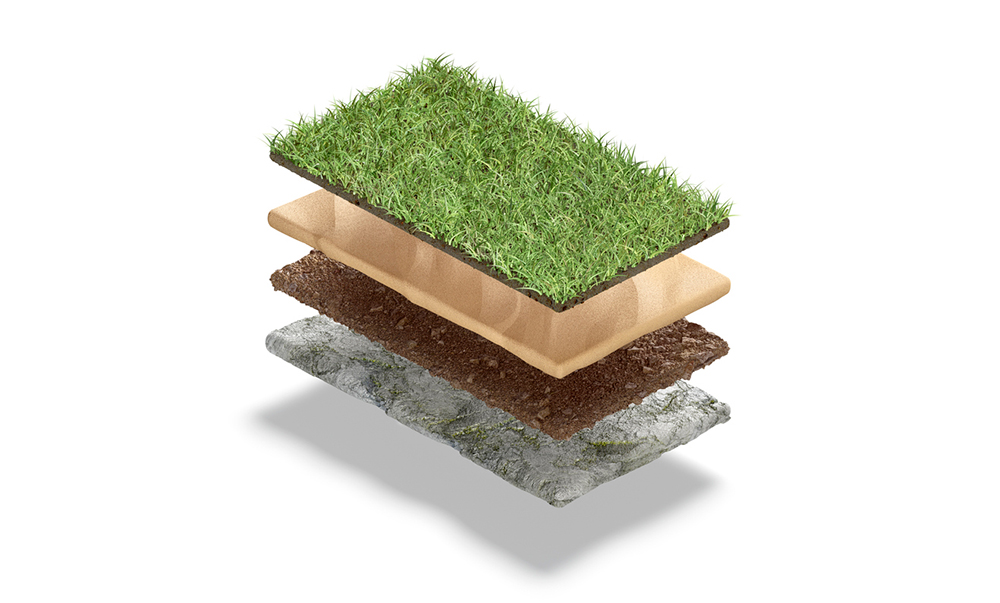
Cutaway view of premium artificial turf illustrating the polyurethane backing and perforated drainage design that keeps water flowing even in freezing conditions.
Temperature Stress Test: What Happens at 20 °F
Fiber response to cold
At temperatures near 20–25 °F—the range of most DFW hard freezes—PE fibers may feel slightly firmer but remain structurally sound. Polyethylene retains over 90% of its tensile strength and flexibility even at sub-zero temperatures, so DFW’s typical freezes are well within its safe operating range. The blades soften again quickly as the surface warms.
Backing system under thermal stress
Polyurethane backings are engineered for extreme durability and dimensional stability. They resist brittleness and adhesive failure even under rapid temperature shifts. Latex backings, by contrast, can become brittle at low temperatures, which is why premium systems avoid them.
Infill behavior in freezing conditions
Granular infills—silica sand, TPE, or coated rubber—don’t freeze into a solid mass because they contain little to no free water. The surface may temporarily crust, but the base system continues to drain once temperatures rise.
In short: DFW’s cold snaps fall comfortably within the engineered limits of modern synthetic turf systems.
When DFW Gets Extreme: Ice Storms and Hard Freezes
- Typical winter: Overnight frost, thaw by mid-morning.
- Extreme event: Multi-day stretch below 20 °F or measurable ice accumulation.
Ice accumulation vs. light frost
A light frost is harmless and melts quickly. Ice accumulation—usually from freezing rain—can stress seams or drainage points if installation was poor.
- Before a freeze: Ensure drains are clear and debris removed.
- During a freeze: Avoid foot traffic; let ice melt naturally.
- After thaw: Inspect seams and high-drainage areas for movement or infill displacement.
When to call a professional
If seams separate, infill shifts significantly, or drainage seems obstructed, have an installer inspect the base and backing.
Why this is rare in DFW
Prolonged sub-freezing conditions are uncommon, and modern systems are rated for much harsher climates. Most homeowners will never see cold severe enough to test those limits.
Cold Weather vs. Summer Heat: Which Is Harder on Turf?
- Surface temperature extremes: Summer turf can reach 140–150 °F in direct sun; winter surfaces rarely drop below 25 °F. Summer puts way more stress on turf than winter ever could.
- UV exposure: Peak-season UV intensity accelerates polymer aging; winter’s lower sun angle provides a natural recovery period.
- Foot traffic: Warm months bring heavy use—kids, pets, and poolside activity—while winter reduces mechanical wear.
- Expansion and contraction: Daily summer heat expansion stresses seams far more than mild winter contraction.
- Overall aging: Most material fatigue occurs in summer, meaning winter is a recovery phase, not a risk.
Bottom line: DFW’s cold season is the easiest stretch of the year for artificial turf.
DFW-Proof Design, Pinnacle Installation
At Pinnacle Turf Solutions, we specify systems engineered for Texas extremes—premium polyethylene fibers, polyurethane backings, and balanced infill blends designed for drainage and durability. Our installation standards ensure proper base compaction, seam integrity, and temperature-tolerant adhesives, so your turf stays green and stable year-round.
Ready for Year-Round Green?
Looking for seasonal care steps like brushing and drainage maintenance?
👉 Read our Fall & Winter Turf Care Guide — your resource for practical upkeep.
Want to extend your turf’s lifespan?
👉 Check out How Long Artificial Turf Lasts in DFW to understand how materials and installation quality drive longevity.
For consultations or installations built to handle every DFW season, contact Pinnacle Turf Solutions today.